sk8r
Set a project up, install it and verify it starts after one approval, with a plan you can preview and undo.
The problem
Momentum dies between cloning a project and getting it running: the interpreter, package manager, missing settings and start command all need decisions, and an AI assistant can guess wrong at each one.
The constraint
A readiness check cannot prove a server started. Setup must be reviewable, preserve existing settings and leave other people's processes alone.
The approach
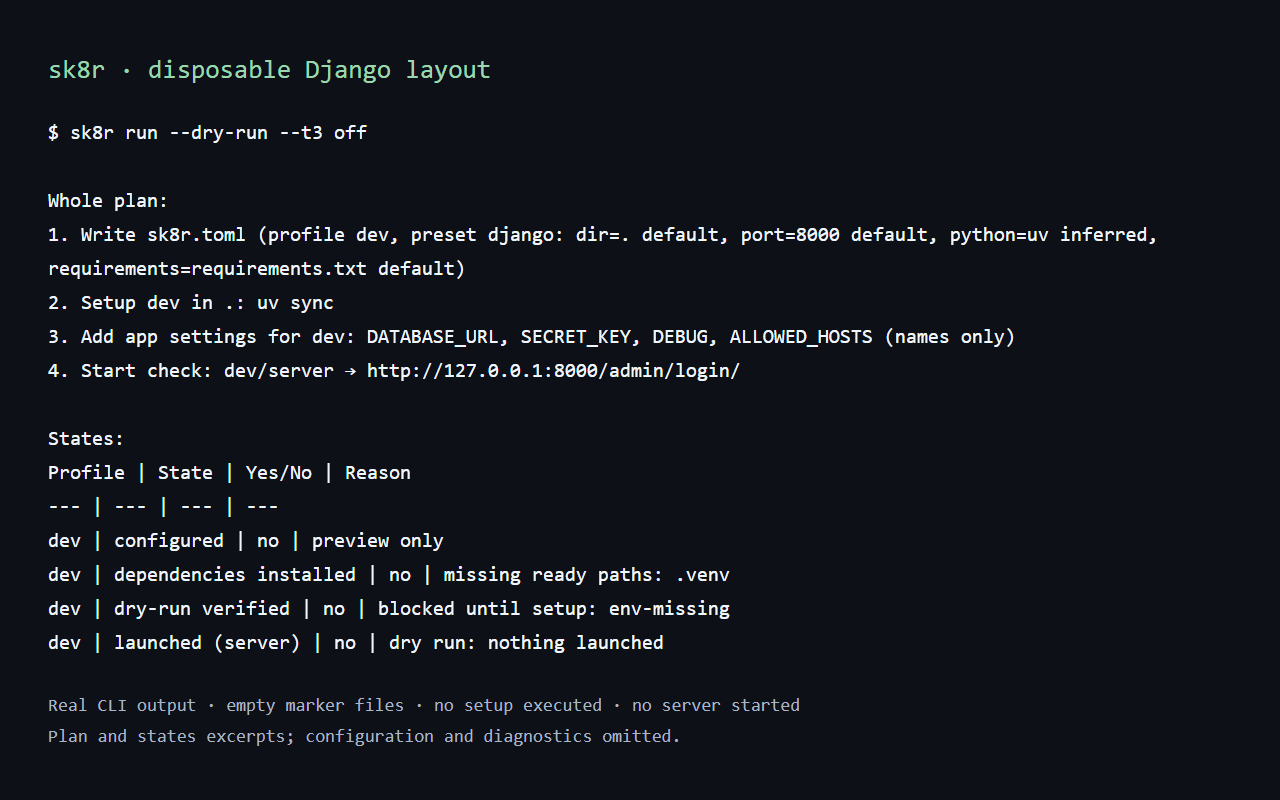
Data-only presets and inference from project files produce a numbered plan. After approval, sk8r records setup, fills missing local settings without printing values, adds T3 Code buttons and checks for an HTTP answer. A project's declared commands run only after the user approves them once on that machine, and any change asks again. A journal supports undo while leaving later user edits alone. Configured, dependencies installed, dry-run verified and launched are reported separately.
The outcome
Released as 1.0 on PyPI (`uv tool install sk8r`) under MIT, marked Beta. T3 Code-centred, with field results from three projects on one Windows machine: Operations API reached HTTP 200 in about 11 seconds after one approval with packages already installed, a fresh install set Rootstock up in 88 seconds, and Lead Platform's launch is unconfirmed. macOS is covered by CI only; reports from Mac users are welcome.
Engineering notes
- The Operations API field report records one approval to HTTP 200 in about 11 seconds; dependencies were already present.
- A fresh install from GitHub set up Rootstock in 88 seconds with one approval; its five findings became 1.0 fixes.
- A repository's commands run only after you approve them; the approval lives outside the repository and any change asks again.
- sk8r undo previews and reverses journalled changes, including replaced editor buttons, while keeping later user edits.
- App settings diagnostics show key names only; sk8r never prints or journals .env values.
- CI runs on Linux, macOS and Windows with Python 3.11 and 3.15, and each release is installed and run on all three before it reaches PyPI.
- MIT licensed, with Python's standard library as the only runtime dependency.